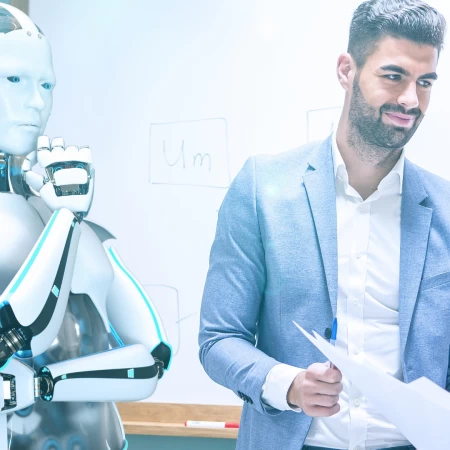
LESSON OVERVIEW
Innovation. Technology. The cutting edge. And…the pink slip? In this lesson, students will explore how work will change in the future due to recent shifts in job market trends. Students will learn and practice relevant vocabulary by participating in engaging discussion activities about the job skills needed for the future. The lesson features a video with predictions about the future of work. The lesson activities have been developed for both adult and teenage learners, ensuring an insightful and interactive learning experience.
LESSON OBJECTIVES
Listening: Students will Improve listening skills by watching a video about the future of work, focusing on key predictions, the impact of automation, and the importance of reskilling.
Speaking: They will engage in discussions about the future of work, sharing opinions on automation, new job roles, and necessary skills for future success.
Vocabulary: Learners will use vocabulary related to job market trends and future skills, including specific job titles and terms related to economic changes.
Homework: Students will be tasked with identifying phrases with similar meanings, completing sentences with correct vocabulary related to job trends, and correcting mistakes in sentences about future work predictions.
VIDEO
What does the future hold for the job market? A lot of jobs are getting irrelevant, but, at the same time, new ones are created. This video talks about what we need to do to prepare for the job market in the upcoming years.
VIDEO TRANSCRIPT
– COVID-19 is one of the biggest crises of our time. It has impacted every single one of us shaken our social systems and disrupted every sector of our economies. The automation of work, combined with a global recession led workers to lose their jobs at an accelerated pace compared to previous years. And this trend is expected to continue. The ongoing shift in the division of labor between humans, machines and algorithms might displace 85 million jobs worldwide in the next five years. While 97 million new roles, ones that are more adapted to this new task distribution may emerge. By 2025, companies expect to displace roughly 6% of their total workforce, one in two workers will need reskilling and those remaining in their current roles will need to update 40% of their skill set to adapt to the changing labor market. There is a way to collectively benefit from these challenging times. Decades of research have shown that the most valuable asset of any economy or company is its human capital. Around the globe, companies are already experiencing a shortage in relevant skills for future roles, and are investing in reskilling and upskilling their workforce. By 2025, organizations say they will train over 70% of their employees to ensure they can smoothly transition into the jobs of tomorrow. These include DevOps engineers, artificial intelligence specialists, digital marketing managers, talent acquisition specialists, and customer success specialists. It will take on average between two weeks and five months for workers to pick up new skills, allowing them to move into these new roles. That data shows they won’t need to have the perfect skill set to start transitioning. While two thirds of employers expect to get a return on investment in employees reskilling programs within just one year. Governments will also need to step in to update and fund education and training systems and to ensure displaced workers have adequate safety nets. With purposeful leadership and collaboration. We can turn this global crisis into a unique opportunity to transition into a future of jobs that is inclusive, fair and sustainable.
VOCABULARY AND PRONUNCIATION
- automation [noun]: the use of machines or computers instead of people, especially in a factory or office
- recession [noun]: a period when the economy of a country is not doing well, industrial production and business activity are at a low level
- upskilling [noun]: the process of improving workers’ skills
- inclusive [adjective]: including everything or all types of people
- sustainable [adjective]: able to continue at the same level for a period of time
- emerge [verb]: to become known or develop as a result of something; to appear
- human capital [noun]: employees, and all of their knowledge, skills, experience, etc., which makes them valuable to a company or economy
- shortage [noun]: a lack of something needed
- asset [noun]: a person or thing that is very useful or valuable
- displaced worker [noun]: a worker who has lost their job because the company they work for has failed or closed down
- step in [phrasal verb]: to become involved
- safety net [noun]: something, especially a government program, that protects or helps people with financial problems