LESSON OVERVIEW
Celebrating Roots! This lesson explores the rich traditions and meaning of Kwanzaa, a week-long celebration honoring African-American culture and heritage. Students will watch an engaging video to learn about the history, traditions, and significance of this holiday while expanding their vocabulary with diverse examples. The lesson includes interactive activities and thought-provoking questions designed for teens and adults. It’s a perfect opportunity to build cultural awareness while improving English skills.
LESSON OBJECTIVES
Grammar: Students will practice using mixed tenses such as Past Simple, Present Simple, and Present Perfect while discussing the history and traditions of Kwanzaa. Activities will encourage them to form sentences with verbs like celebrate, represent, and build, helping them describe events and concepts related to the holiday.
Listening: Students will watch a video about Kwanzaa, focusing on understanding the holiday’s origins, the seven principles, and key symbols. They will improve their listening comprehension by answering questions, such as “Who started Kwanzaa?” and “What do the candles represent?” to ensure they grasp essential details.
Speaking: Students will engage in discussions about Kwanzaa and compare it to their own cultural traditions. Through guided questions like “Why do you think it’s important to celebrate heritage?” they will share ideas, practice new vocabulary, and build confidence in expressing opinions.
Vocabulary: Students will learn key Kwanzaa-related terms and expressions, including heritage, unity, principles, traditions, community, and cooperative economics. Matching exercises and contextual practice will help them use these words naturally in conversations and written tasks.
Cultural Awareness: Students will explore the cultural significance of Kwanzaa and its role in honoring African-American heritage. By learning about symbols like the Kinara and principles such as Umoja (unity) and Kuumba (creativity), they will develop an understanding of the importance of cultural celebrations in fostering identity and community.
Homework: Students will complete tasks to reinforce their understanding of Kwanzaa, including true/false statements, matching candle colors to their meanings, and writing a guide on how to celebrate Kwanzaa. These activities will encourage reflection and help solidify vocabulary, concepts, and cultural knowledge introduced in the lesson.
VIDEO
What is your favorite holiday celebration? Do you enjoy family time, food, music, events, or something else? Watch this video to learn about the history, traditions, and significance of Kwanzaa.
VIDEO TRANSCRIPT
Kwanzaa. There are many holidays celebrated throughout the year in the United States as well as in other parts of the world. One of these holidays is called Kwanzaa. The name Kwanzaa comes from the Swahili phrase matunda ya kwanza, which means “first fruits of the harvest.” The holiday was created in 1966 by Dr. Maulana Karenga. Dr. Karenga was a professor and chairman of Black Studies at California State University in Long Beach, California. Dr. Karenga started this holiday because of some recent riots or fights that had broken out in a Los Angeles neighborhood. He wanted to find a way to bring African Americans together as a community. His goal was to create a holiday where African Americans could celebrate their culture and their history.
Kwanzaa festivities are based on African harvest celebrations. Those celebrations revolve around newly harvested or planted crops. Since it began in 1966, Kwanzaa has been celebrated by African Americans throughout the United States. It is a seven-day non-religious celebration that begins December 26th and ends January 1st. There are many traditions that are celebrated during the seven days of Kwanzaa, but at the heart of the Kwanzaa celebrations are seven symbols and seven principles.
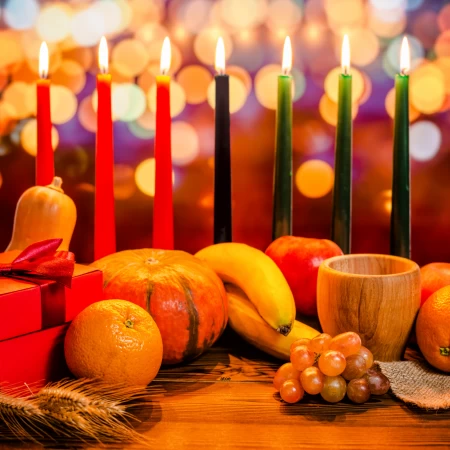
Here is a look at each of the seven symbols of Kwanzaa and what they represent. Kikombe Cha Umoja means the unity cup. Drinking from this cup on the sixth day of Kwanzaa is meant to honor and remember African ancestors. It is also a sign of unity. Before drinking from the cup, each person says harambee, meaning “let’s pull together.” Kinara is the name of the candle holder. The Kinara holds seven candles, and the candle stalks symbolize corn that branches off to form new stalks. This is symbolic of how the human family is created. It also celebrates the idea that through children, future hopes of each family come to pass. Mazao is the name for crops. Fruits, nuts, and vegetables represent the crops and the work that went into growing them. During Kwanzaa, fruits, nuts, and vegetables are placed on a special mat as gifts for everyone to enjoy. These foods are a reminder to the people celebrating Kwanzaa of the fruits that nourish the people of Africa.
Mishumaa Saba is the name for the seven candles that sit on top of the Kinara. The seven candles represent the seven principles of Kwanzaa. The three colors of Kwanzaa are red, black, and green. They are important symbols in ancient Africa. Green symbolizes the fertile land of Africa and represents the future. Black is the color of the people, and red represents the blood that was shed in the struggle out of slavery. Three red candles are placed on the right side of the Kinara, and three green candles are placed on the left side. One black candle, which symbolizes unity, is placed in the middle. One candle is lit during each day of Kwanzaa.
Mkeka means placemat. It is the base for the six symbols of Kwanzaa. This straw mat symbolizes a foundation. Nothing can be built without having a foundation on which to sit. The mat is where the gifts of Kwanzaa are placed. Vibunzi means ear of corn. One ear of corn is placed on the Mkeka for each child present. Fruits and vegetables are laid down to represent people who work hard in the field. Zawadi means gifts. On January 1st, the last day of Kwanzaa, handmade, educational, and cultural gifts are given. People celebrating Kwanzaa decorate with red, black, and green African-style fabrics, art, and clothing.
For each of the seven nights, families gather and someone lights one of the special candles on the Kinara; usually, it is a child who gets to do this. Following the lighting of the candle, one of the seven principles is discussed among family and friends. The symbols of Kwanzaa are closely connected to the seven principles.
Here is a list of the seven principles of Kwanzaa. Umoja means unity. This principle is about building a strong family, race, community, and nation. It encourages people to come together physically and ethically. Umoja believes that when people come together, they are capable of anything. Kujichagulia means self-determination. An example of this principle is to speak up for yourself. You don’t need to wait for someone else to define who you are; you are the one that creates your own identity. Ujima means collective work and responsibility. This principle is about helping others within your community. It says that we best solve our problems when we do it together. Ujamaa means cooperative economics. This principle encourages African Americans to build and maintain their own stores and businesses and suggests that the community will all profit from those stores and businesses. Nia means purpose. It encourages people to find their purpose as well as to protect their legacy. It also teaches African Americans to build up and develop their communities. Kuumba means creativity. This principle talks about doing as much as you can to leave the community better and more beautiful for future generations. Imani means faith. It is about believing with all your heart in your people, parents, teachers, and leaders, and the righteousness and victory of their struggle. It teaches that without faith in your community, your community cannot survive.
The tradition of the seven symbols and the seven principles of Kwanzaa are values of African culture. They contribute to building and reinforcing community among African Americans. On December 31st, there is a feast held as part of the Kwanzaa holiday called the great feast of Karamu. The three colors of Kwanzaa—red, black, and green—are especially important during this feast. The feast is held at a home, church, or community center that is decorated in an African motif. The feast includes traditional African dishes as well as dishes with ingredients brought to the U.S. by Africans, such as sesame seeds, peanuts, sweet potatoes, collard greens, and spicy sauces. The foods are placed on and around a large Mkeka, and a program is given as part of the festivities. Like all special holidays, every family celebrates Kwanzaa in its own way. Most celebrations include songs and dances, African drums, storytelling, poetry, and a large traditional meal. Millions of people every year celebrate Kwanzaa. It is a special week honoring the values of African culture while inspiring African Americans throughout the United States.
Thanks for following Clarendon Learning. Be sure to subscribe for more free resources. Check us out at clarendonlearning.org.
VOCABULARY AND PRONUNCIATION
- celebrating roots [verb phrase]: honoring and appreciating one’s ancestry, culture, and history
- Kwanzaa [noun]: a week-long holiday celebrating African heritage, culture, and values, observed from December 26 to January 1
- culture [noun]: the traditions, customs, and way of life shared by a group of people
- symbol [noun]: an object, word, or image that represents a concept or idea
- heritage [noun]: the traditions, history, and values passed down from previous generations
- principle [noun]: a basic idea or rule that guides actions and beliefs
- harvest [noun]: the gathering of crops, often celebrated as a time of gratitude and community
- Kinara [noun]: a candle holder used during Kwanzaa, holding seven candles to represent the seven principles
- Umoja [noun]: unity; coming together as a family, community, or nation
- Kujichagulia [noun]: self-determination; defining and creating your own path
- Ujima [noun]: collective work and responsibility; working together to solve problems and build a better community
- Ujamaa [noun]: cooperative economics; supporting and building businesses within the community
- Nia [noun]: purpose; focusing on goals to strengthen and uplift the community
- Kuumba [noun]: creativity; using imagination to improve and beautify the world
- Imani [noun]: Faith; believing in oneself, others, and the future