LESSON OVERVIEW
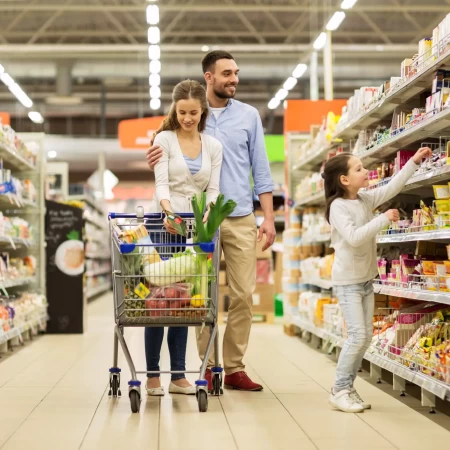
Let’s go grocery shopping! In this lesson, students will learn how to buy groceries at a store and ask for help when looking for items. The lesson includes audio of two people communicating in a store, along with plenty of engaging discussion activities and worksheets. Students will review and practice vocabulary related to this topic. Additionally, students will discuss different aspects of grocery shopping and share ideas on buying goods. The lesson activities have been developed for both adult and teenage learners, ensuring a practical and interactive learning experience.
LESSON OBJECTIVES
Grammar: Students will focus on the use of “can” for requests and permissions within the context of shopping. Exercises will include forming questions like “Can you show me where the eggs are?” and statements such as “You can find bread in aisle three.”
Listening: Students will listen to an audio clip featuring a conversation in a grocery store, focusing on how customers ask for help and how employees respond. This will help students understand practical language used in shopping environments.
Speaking: Through guided discussions, students will talk about their own shopping experiences and preferences. They will practice asking for items, describing what they need, and interacting with store employees and other shoppers.
Vocabulary: Key terms related to grocery shopping will be introduced, such as “aisle,” “cashier,” “conveyer belt,” “shopping cart,” and types of food items like “dairy” and “produce.” Students will learn these words through matching activities and use them in context.
Cultural Awareness: Discussion may explore different shopping habits and store formats around the world, examining how cultural contexts influence shopping behavior and consumer choices.
Homework: Students will complete tasks involving vocabulary matching, sentence completion about shopping experiences, and creating a shopping list from a given set of meal plans. These activities will enhance practical understanding of grocery shopping.
AUDIO
Listen to the audio of a man asking an employee for help at a grocery store. Are eggs, milk, bread, or fruit on your shopping list? I hope you are not a deer in headlights, like this customer, and can find your way down each aisle. Grab your shopping cart, and let’s go shopping!
AUDIO TRANSCRIPT
– Excuse me, miss. Do you work here? – Yes, I do! How can I assist you? – Can you help me find the eggs? – Eggs? Yes, of course. Follow me, please. – Thank you so much. I have looked down every aisle and can’t seem to locate them. – No worries! We just rearranged a few things, so I apologize for that. We have eggs of different colors, sizes, and types. What are you looking for exactly? – Um, let me double-check my shopping list. Usually, my wife does the shopping. I feel like a deer in headlights in these big supermarkets. I think large white free-ranged eggs should be ok. – (laughs) I understand. I work here and sometimes get confused! Anyway, are you looking for a full dozen or just half a dozen eggs? – Two dozen actually! My wife and I plan to make some omelets, pancakes, and sausage for our kids on Sunday. – Wow, sounds delicious! Can I come? (laughs) Here we are! – Well, if you come, we might need three dozen eggs! (laughs)
VOCABULARY AND PRONUNCIATION
- shopping list [noun]: a list of purchases to be made
- cashier [noun]: a person handling payments and receipts in a shop, bank, or business
- supermarket [noun]: a large retail market that sells food and other household goods
- bagger [noun]: a person whose job is to put customers’ purchases into bags at a supermarket or other store
- credit card machine [noun]: device used to collect payments from customers who wish to pay by credit or debit card
- shopping cart [noun]: a four-wheeled cart provided by a supermarket or other retail store for a customer’s use in collecting purchases
- food groups [noun]: a collection of foods that share similar nutritional properties
- dairy [adjective]: containing or made of milk; relating to milk, cream, butter, cheese, etc.
- produce [noun]: of or relating to fruits and vegetables
- coupon [noun]: a voucher that gives a discount off a particular product
- free-range [adjective]: allowed to walk around and feed with relative freedom; of livestock or domestic poultry
- half a dozen [idiom]: a group of six
- a dozen [idiom]: a group of twelve
- be a deer in headlights [idiom]: to be surprised, confused, or frightened so much that you cannot think or move
- sell like hot cakes [idiom]: something is bought by many people