LESSON OVERVIEW
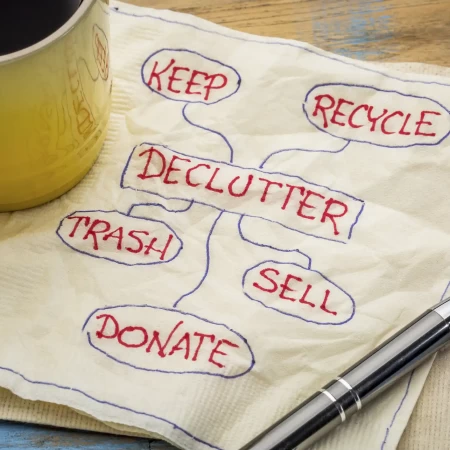
Less is more! In this lesson, students will explore the topics of decluttering and hoarding habits. The lesson features a video about spring cleaning and organizing the home. Students will learn and practice relevant vocabulary related to decluttering. The lesson includes plenty of engaging discussion activities and worksheets developed for both adult and teenage learners, ensuring a practical and interactive learning experience.
LESSON OBJECTIVES
Listening: Students will listen to a discussion in a video about decluttering and spring cleaning, enhancing their understanding of strategies for organizing and minimizing possessions.
Speaking: They will discuss their own experiences with decluttering and managing hoarding habits, sharing personal strategies and challenges faced during the process.
Vocabulary: The lesson introduces vocabulary related to decluttering, such as “clutter,” “declutter,” “donate,” “recycle,” and “minimize,” expanding students’ ability to talk about cleaning and organizing spaces.
Homework: Tasks include writing correct words based on descriptions, matching descriptions with people, and choosing the correct answer for multiple-choice questions to reinforce the vocabulary and concepts learned.
VIDEO
Are you a hoarder? Do you enjoy spring cleaning? Watch this video to learn about some tips for decluttering your home.
VIDEO TRANSCRIPT
-Welcome back. Spring is strong and decluttering your home is a great start to major spring cleaning. -Please welcome the woman who literally wrote the book about it, but then she threw it away because she didn’t want to have clutter, Tisha Morris everybody. Here she is.
-Hey Tisha. Welcome.
-Good to see you, Tisha. All right. This looks familiar. All this looks familiar. So, actually I love starting with the clothing closet first [oh, okay] because it’s the
-Should we go to the clothes first?
-Oh, all right.
-It’s the space that
-Yeah, no, here.
-It’s right there.
-Let me go in the closet.
-So, it’s the space that’s most personal to us. And so therefore, you can have the quickest change. So, anything that’s over two years old, two years old.
-I’m going to be naked, Tish.
-So, anything that’s older than that, I recommend donating it to chattel border organizations. And it’s those sweatshirts from college, that party dress from college that really get us stuck [right]. But they represent the past [yeah]. So, we want to be here in 2019.
-Here’s my problem. I always go, what if it comes back? And then I’m sorry I got rid of it because
-I kind of like this.
-Well, that’s your excuse to go shopping.
-Yeah, okay. Good point.
-Do you mind if I keep that? I kind of like this one.
-He’s gonna reclutter.
-All right, next.
-So, papers. They cause so much anxiety. And there’s actually lots of research now that shows that cluttered space leads to clutter mind.
-I agree with that.
-So, you can immediately cut it down by tossing junk mail [junk mail]. And just keep one stack, even in your kitchen, of just your inbox. And those are the things you need to tend to. Anything else either gets tossed or gets filed away outside of your everyday spaces.
-Okay. No one is throwing away my favorite movie ever.
-What movie is that?
-Under the Tuscan Sun. I love this.
-You can keep you can keep your favorites. All right, but anything else you can stream.
-But no one’s really watching these right? [Right] It’s all it’s all stream [right]. And then home movies, digitized [right]. That way you can find you can keep your favorite ones, you can get it put on the thumb drive, [yeah] give it away for Christmas gifts.
-Oh my gosh, that’s great.
-Erasure please I’m holding that.
-He’s gonna he’s literally rebuilding his nest right now.
-So, this is actually sometimes when decluttering you can find some of your favorite things that you forgot about [that’s true]. So, bath products, they clog our cabinets, it causes stress that you don’t need in the morning. And so, we have lots of unused products maybe they’re the wrong color, the rain wrong, maybe they made your hair frizzy. So, pour them out, recycle. It’s Earth Day so great time to, you know, don’t want to make your cabinets its own landfill.
-Yeah, right.
-Right. Correct.
-That’s true.
VOCABULARY AND PRONUNCIATION
- less is more [idiom]: used to express the view that a smaller quantity could be of higher quality
- declutter [verb]: remove unnecessary items from (an untidy or overcrowded place)
- hoarder [noun]: a person who collects, saves, and keeps many things
- compulsive hoarding [noun]: where someone acquires an excessive number of items and stores them in a chaotic manner, usually resulting in unmanageable amounts of clutter
- clutter [noun]: a collection of things lying about in an untidy state
- junk mail [noun]: unwanted or unsolicited advertising or promotional material received through the post or sent as email
- expired [adjective]: having passed its expiration date; no longer good for consumption
- cosmetics [noun]: make-up or beauty products
- junk drawer [noun]: a drawer designated for the storage of various miscellaneous, small, occasionally useful items of little value
- modern [adjective]: relating to the present or recent times as opposed to the remote past; contemporary or current
- old-fashioned [adjective]: in or according to styles or types no longer current; not modern
- minimalist [noun]: a person who strives to only use things that they really need and serve a purpose