LESSON OVERVIEW
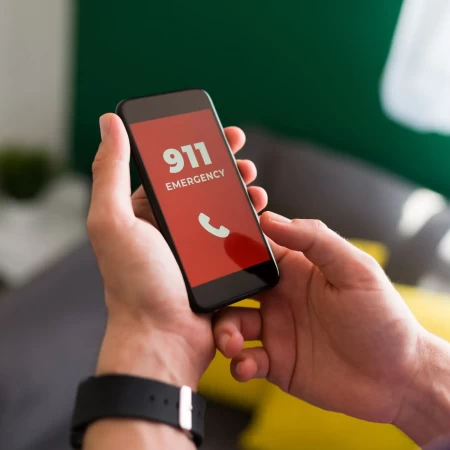
911, what’s your emergency? In this lesson, students will learn how to call 911 and identify possible reasons for calling in an emergency situation. Students will listen to a 911 call and discuss important things to do and remember in an emergency. Students will also learn and practice compound relative pronouns and learn and practice vocabulary and idioms relating to this topic. Aimed at both adults and teens, it includes exercises to make learning practical. Students will also work on worksheets and review key vocabulary terms for homework, helping them remember important points.
LESSON OBJECTIVES
Grammar: Students will learn how to use compound relative pronouns such as “whoever,” “whatever,” “wherever,” “whenever,” “whichever,” and “however.” These will help them form complex sentences applicable in various emergency situations.
Listening: They will improve their listening skills by focusing on a 911 emergency call simulation. Students will learn to identify key information and instructions, crucial for understanding real-world emergency communications.
Speaking: Students will engage in role-play exercises to simulate emergency calls, enhancing their ability to communicate clearly and effectively in stressful situations. This practice will also reinforce their understanding and use of compound relative pronouns in context.
Vocabulary: Vocabulary development will focus on terms and idioms related to emergency situations, such as “first responders,” “unconscious,” and “pulse check.” These terms are essential for discussing and understanding emergency procedures.
Cultural Awareness: Students will explore the function and importance of emergency services in different cultures, including how to appropriately interact with emergency operators and what information is vital during an emergency call.
Homework: Homework will involve exercises that reinforce the use of compound relative pronouns through emergency-based scenarios. Students will complete sentences and match pronouns to their correct usage, apply this knowledge to describe actions in emergency scenarios, and reflect on the correct steps to take during hypothetical emergency situations such as a subway incident.
AUDIO
Listen to the audio of a 911 call between an operator and a young man who is in a park during an emergency situation. The young man might have to perform CPR on his friend if the ambulance does not race to arrive on time!
AUDIO TRANSCRIPT
– 911, what’s your emergency?
– (concerned/scared tone) Uh…hello. I…I need help.
– Okay, sir. My name is Chelsea. What seems to be the problem?
– (concerned/scared tone) My friend collapsed on the grass, and I think he is unconscious!
– Okay. I will help with whatever you need, but I need you to stay calm. I need some information from you. First, what is your name, and how old is your friend?
– My name is George. My friend is 20 years old.
– Okay, George. Where are you right now?
– Uhh, we are at the park. The…the Jefferson Green Park.
– Okay. Is your friend breathing? You need to check his pulse.
– Um, I think I can do that. Hold on. (checks pulse) Yes, he is!
– Okay, that is good. An ambulance is on the way to you right now. Whatever you do, do not leave your friend.
– Tell whoever is coming to please hurry!
– Don’t worry. They will arrive in five minutes. The first responders will find you wherever you are.
– Thank you whoever you are!
– Of course, George. You are in safe hands. Please stay on the line until the ambulance arrives.
VOCABULARY AND PRONUNCIATION
- stop, drop, and roll [noun]: a simple fire safety technique taught to children, emergency personnel, and workers as part of health and safety training in North America and most other English-speaking countries
- first aid kit [noun]: a set of materials and tools used for giving emergency treatment to a sick or injured person
- first responder [noun]: a person (such as a police officer or an EMT) who is first to arrive at the scene of an accident or emergency to provide assistance
- burglary [noun]: the act of breaking and entering a place to commit a crime
- kidnapping [noun]: the illegal act of holding a person against their will, often including transportation
- pepper spray [noun]: a type of disabling spray that causes irritation and blinding of the eyes, nose, throat, and skin
- dead phone battery [noun]: a phone battery that has no more electricity
- collapse [verb]: to fall abruptly and completely
- unconscious [adjective]: not knowing or perceiving; not aware
- pulse [noun]: a rhythmical beating, vibrating, or sounding caused by the heart
- in safe hands [idiom]: means you are looked after by a reliable person, and there is no risk
- on the line [idiom]: the act of speaking on the telephone
- CPR [noun]: a medical treatment in which you breathe air into someone’s mouth and press on their chest to make them start breathing
- Heimlich maneuver [noun]: a first aid procedure used to treat choking in which a person does chest thrusts to help clear the airway
- hang on for dear life [idiom]: used when you are in a dangerous situation, and you need to grip something firmly, so you do not fall