LESSON OVERVIEW
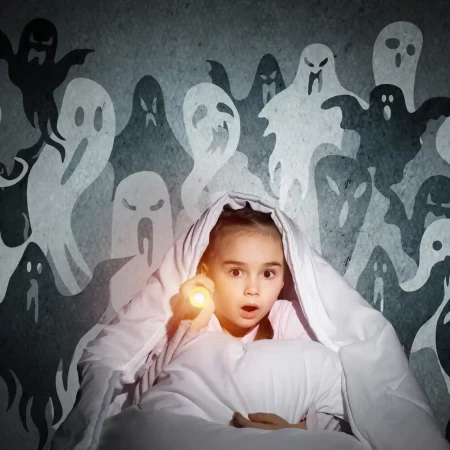
Spiders? Heights? Things that go “bump” in the night? This lesson focuses on fear and the things that make our hearts skip a beat. Students will participate in plenty of engaging discussion activities and fun tasks while they learn and practice phrases and idioms related to being afraid. Additionally, students will watch a video that shares interesting facts about fear. The lesson activities and worksheets have been developed for both adults and teenagers, ensuring an exciting and immersive learning experience.
LESSON OBJECTIVES
Grammar: Students will learn and practice using phrases that express fear or anxiety, such as “scared to death,” “shaking like a leaf,” and “nerves of steel.” This will help them understand how to describe emotional states in English.
Listening: Students will listen to a video about fears and phobias, identifying key terms and phrases related to fear. They will practice distinguishing between different types of fears and the language used to describe them.
Speaking: Students will participate in discussions about personal fears and phobias, using the vocabulary and phrases learned. They will express their feelings about various fears and share stories about times they felt scared.
Vocabulary: Students will learn vocabulary related to fear, such as “hair-raising,” “jumpy,” “fearless,” and “the creeps.” They will practice these words in various speaking and writing exercises to enhance their vocabulary retention.
Homework: Students will complete a worksheet where they must use new vocabulary in sentences, match phrases to their meanings, and write a short paragraph about their biggest fear and how they manage it. This will reinforce their learning from the lesson and encourage personal reflection on the topic of fear.
VIDEO
Do you like being scared? You may not, but some people like being afraid. That’s right! Watch this video and learn what drives people to watch horror movies or take a ride on a rollercoaster.
VIDEO TRANSCRIPT
One: Some people prefer the treat while others prefer the trick. That’s right. Some people like being afraid. They watch horror movies, they ride roller coasters, and they often take us along for the ride. But why do these people like being scared? Isn’t fear an inherently negative emotion? When scared our instinctual survival response kicks into action. This floods our body with hormones and neurotransmitters, making us stronger and faster. Adrenaline is a hormone that plays a huge factor and gives us the rush some people crave. Fact number two: Most of our fears are nurture and not nature. We are born with two innate fears: heights and loud sounds. Most other fears are learned. As children, we learned that snakes are scary based on the surrounding adult’s reactions to snakes. Three: The more scared you are, the scarier things appear. Once scared, your heartbeat is increased, and you’re on red alert for danger. This makes your body more jumpy than usual, at least until the fight or flight response wears down. Four: Fear guides decisions. Do you ever catch yourself going for the safe choice? Everyone does. Fear stops us from doing things we may want to do. And funnily enough, it also guides us into doing things we don’t want to do. As a species, we’re more scared of the stick than we want the carrot. And in a lot of cases, the stick doesn’t even exist. Five: We can literally smell fear off of other humans. We can tell when others are scared from what their sweat smells like. Although this is all unconscious so you can exactly sniff your friend’s armpit during a scary movie. Even though we may not realize through our noses our brain can tell when specific fear chemicals are released from your peers sweat. Fear plays a huge part in our lives. From roller coasters to skydiving. Do you like it? Does it control you? Do you smell other people’s armpits?
VOCABULARY AND PRONUNCIATION
- fight or flight [phrase]: the instinctive physiological response to a threatening situation, which readies one either to resist forcibly or to run away
- kick into action [idiomatic phrase]: to start doing something quickly and effectively, especially something that you have been trained to do
- crave [verb]: to want or yearn for greatly
- carrot-and-stick [adjective]: characterized by the use of both reward and punishment to get cooperation
- nurture [noun]: the process of caring for and encouraging the growth or development of someone or something
- scared stiff [idiom]: very afraid or frightened
- fearless [adjective]: brave; free from fear
- instinctual survival response [noun phrase]: the process of a person or animal preventing itself from being harmed or killed; basic behavior in most living things
- adrenaline rush [noun]: a physical feeling of intense excitement and stimulation caused by the release of adrenaline from the adrenal glands
- bury [verb]: to put or hide underground or to completely cover; to cause to disappear or become inconspicuous
- put on a brave face [idiom]: to try to appear brave or calm
- jumpy [adjective]: (of a person) anxious and uneasy; nervous
- inherently [adverb]: in a permanent, essential, or characteristic way
- innate [adjective]: inborn; natural
- red alert [noun]: a warning that there is great danger
- hair-raising [adjective]: causing terror, excitement, or astonishment