LESSON OVERVIEW
What a happy accident! In this lesson, students will explore interesting facts about some of the greatest inventions. The lesson features a video that discusses everyday inventions that were created by accident. Students will learn and practice narrative tenses and related vocabulary. The lesson includes plenty of engaging discussion activities and worksheets designed for both adult and teenage learners, ensuring an interactive and informative learning experience.
LESSON OBJECTIVES
Grammar: Students will focus on mastering the use of narrative tenses, which are essential for discussing events and actions in storytelling. They will practice these tenses through activities that require them to recount the origins of various inventions, improving their ability to describe past events.
Listening: Students will enhance their listening skills by engaging with a video that outlines historical instances of accidental inventions. They will concentrate on understanding the details and contexts of these inventions, identifying key points and the sequence of events that led to each discovery.
Speaking: Through discussion and role-play exercises, students will use narrative tenses to share stories and discuss the broader implications of these inventions on society and technology.
Vocabulary: The lesson will introduce and practice vocabulary related to inventions, including terms like “patent,” “prototype,” and “innovate,” as well as phrases used to discuss dinventions. These terms are vital for articulating complex ideas about innovation and serendipity in technology.
Homework: Students will engage in exercises that reinforce the vocabulary and grammatical structures discussed during the lesson. Tasks will include creating sentences using narrative tenses, rewriting sentences to correct tense errors, and discussing the role of serendipity in scientific discovery.
VIDEO
Have you ever wondered how potato chips or Coca-Cola were created? It might not be how you imagined it. Watch this video and learn about how some of the greatest inventions we know and use every day were created by accident. You may be surprised to see what’s on the list!
VIDEO TRANSCRIPT
Matches
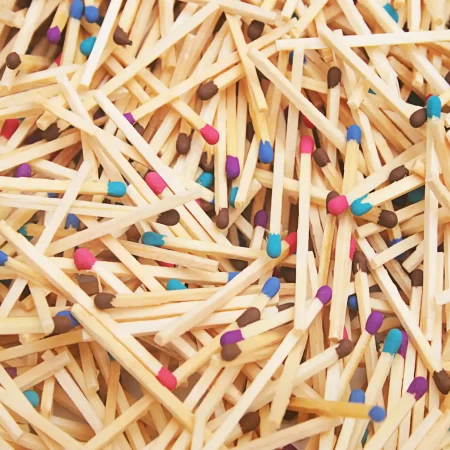
In the early 1800s, British pharmacists, John Walker would routinely prepare medicines using wooden sticks to mix the chemicals together. One day, he noticed that one of the sticks had some substance stuck to it. When he tried to scrape it off, the stick caught fire. And that’s how he came upon this brilliant idea to make life easier in the world with no electricity. He started making and selling these cardboard matches, which he later replaced with three-inch wooden sticks. Accompanied by a piece of sandpaper to light them. Walker humbly decided not to patent his invention because he believed it would be easier for him to benefit humanity this way. Matches soon became popular all over the world and are still a useful commodity today.
Teflon
American scientists Roy J. Plunkett was doing research for the company DuPont with a goal of finding a way to make their fridges safer by replacing the hazardous refrigerant Freon with something else. He must have thought it was another failed experiment when he found that the gas mixture he had created just vanished overnight, and all that was left of it in the container was some white waxy substance. That strange substance proved to have some useful qualities. It was nonreactive, nonstick, and resistant to extreme temperatures from minus 100 degrees to 500 degrees Fahrenheit. In 1941, DuPont patented the invention that we all know today as Teflon.
Potato Chips
New York Chef George Crum, great name for a chef, huh? Actually, it’d be better for a baker. Anyway, Chef Crum got a lot of customer complaints that his fries weren’t crispy enough. Crum, a bit annoyed, decided to slice the potatoes as thin as he possibly could, deep fry them in boiling oil and slather them in salt. That ought to show them he probably thought, but to his surprise, people went crazy for the new recipe. Potato Chips have changed a lot since 1853. Today, they come in over 200 different flavors, from the classic sour cream and onion to some pretty bizarre ones like wasabi ginger. Ooh, that sounds good.
Ice-Cream Cones
Ice cream itself is nothing new. The Chinese ate something very similar to it as early as 200 BC. Ice-cream cones, however, were the product of a happy accident at the 1904 World’s Fair in St. Louis. The ice cream booth had been so rushed with customers that it ran out of bowls. Things weren’t so busy in the next booth over where Ernst Hamwi was selling Persian waffles. In a kind gesture, Hamwi started rolling his waffles up into cones and offer them to his neighbor to use instead of bowls. Customers fell in love with the final product. And that’s how the ice-cream cone was born.
Coca-Cola
John Pemberton wasn’t a businessman. He was just a pharmacist trying to find a way to get rid of headaches, so he came up with a simple recipe consisting of two ingredients, coca leaves and kola nuts combined into a syrup. It went on the market in 1886. The syrup was supposed to be mixed with water, but the seller once mixed it with soda by accident. This is how the delicious and refreshing drink we all love today was created.
VOCABULARY AND PRONUNCIATION
- commodity [noun]: anything that you can buy or sell
- sandpaper [noun]: strong paper with a layer of sand or a similar rough substance that is stuck to one side, used for smoothing the surface by rubbing against it
- hazardous [adjective]: dangerous
- vanish [verb]: disappear, especially quite suddenly
- patent [noun]: a legal right a person or company receives to make or sell a particular product or idea, which cannot be copied by others
- slather [verb]: to spread something thickly over something else
- ingredient [noun]: one of the parts in a mixture
- recipe [noun]: instructions how to prepare and cook a particular food, including a list of needed ingredients
- bizarre [adjective]: strange and unusual
- booth [noun]: a small structure just big enough for one person to go into, e.g., phone booth
- cone [noun]: a crisp usually cone-shaped wafer for holding ice cream
- come up with something [phrasal verb]: to think of or suggest an idea or plan; to invent